
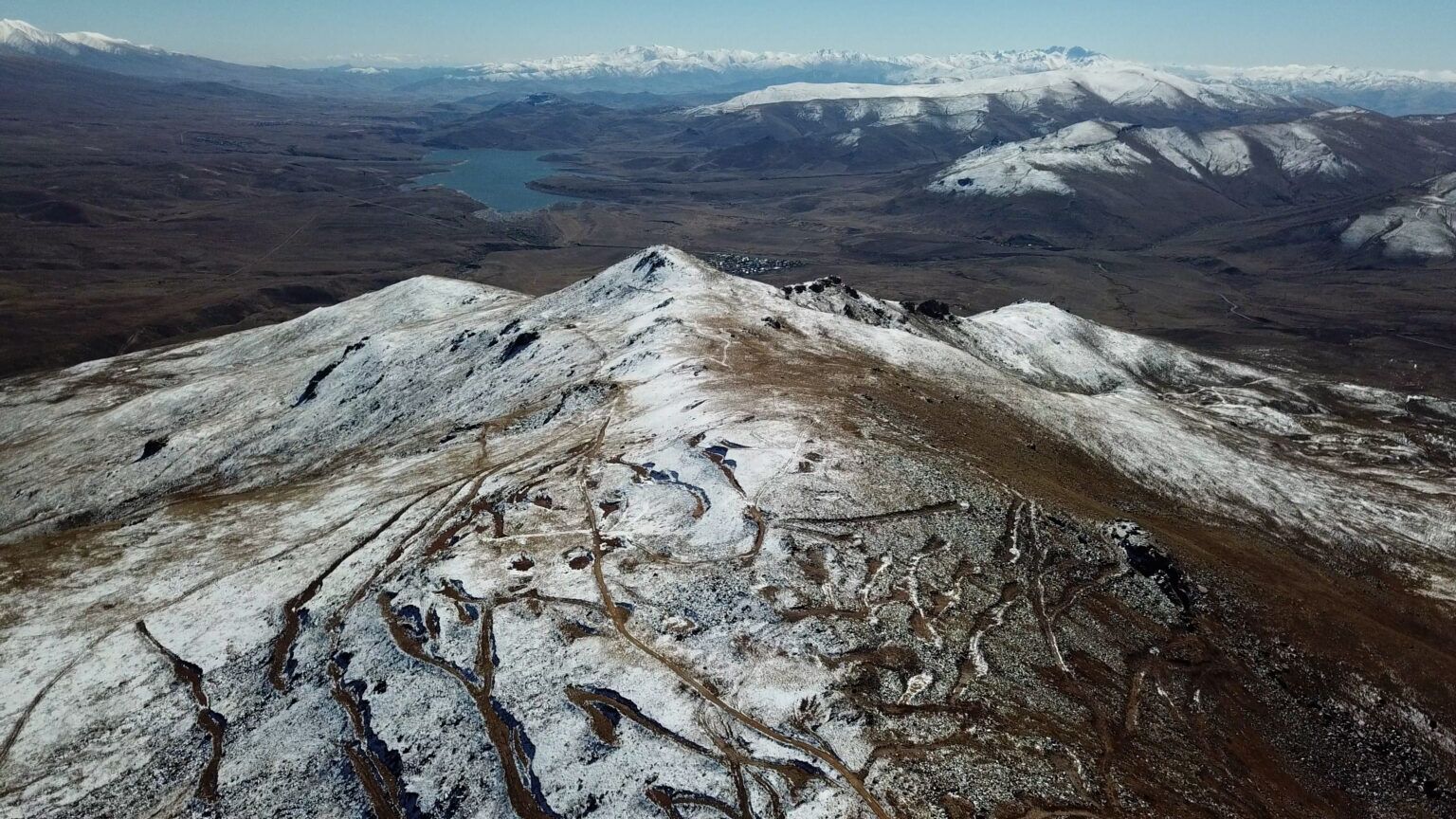
The Amulsar gold deposit is the first mineral deposit discovered in Armenia since the country gained independence. It was identified following nearly a decade of extensive geological exploration and analysis.

The Amulsar gold-bearing quartzite deposit is located on the border of the Vayots Dzor and Syunik regions of the Republic of Armenia. It lies within the ridge area of the northern and north-western branches of the Zangezur Mountain Range, at elevations ranging from 2,500 to 2,988 meters above sea level.
The reserves of the Amulsar gold-bearing quartzite deposit were explored, evaluated, and assigned commercial value through large-scale geological exploration programs conducted by Lydian Armenia at Mount Amulsar.
Structurally, the Project is located on the north-eastern edge of the Zangezur ore zone and hosted by two large ore-bearing and non-metallic sequences.

Ore-bearing, upper volcanic sequence comprises andesitic volcaniclastic rocks, breccias, and tuff (“andesitic coat”), which strikes meridionally about 5,000m, and the thickness is up to 350-400m.
Non-metallic, lower volcanic sequence comprises argillically altered homogeneous, and non-clastic andesitic rocks. The sequence thickness ranges from 100 to 300m (Middle Eocene).
From all sides, the Amulsar tectonic block is bounded by major faults, of which the Kechut-Zirak cross-fault, running along the northern boundary, is noteworthy. From the village of Kechut, this fault extends over the Volcano Zirak to the Vorotan riverheads, and it is characterized by the outcrops of minor intrusions and hydrothermally altered rocks, and the mineralization is localized in its uplifted side.
The Amulsar deposit has independent hydrogeological conditions favorable for the mine operation, mining, and drilling activities. The hydrogeology of the deposit is distinct and has no connection to mineral or freshwater basins or springs, particularly the Jermuk mineral water deposit, which is supplied from a different tectonic block. From Amulsar, it is separated by the deep Kechut-Zirak fault, located in a lower hypsometric area of approximately 1,000 meters and fed from deeper geological layers.
Exploration activities in the Amulsar ore zone identified combined Tigran-Artavazdes, Erato, Arshak, and Orontes sites with its own internal structures.
Reserves of Tigranes-Artavazdes, Erato sites have been approved in accordance with the legislation of the Republic of Armenia, and the right for their operation belongs to Lydian Armenia.
Lydian Armenia owns all the approved reserves of the deposit, amounting to:
Ore
89376.3 Kt
Gold
73733 Kg
0.78 g/t
Silver
294.367 Kg
9.29 g/t
The deposit is to be developed by combined Tigranes-Artavazdes and Erato open pits, with the annual mining output capacity of 10 Mt of ore.
Industrial Process

Heap Leaching
Gold extraction at Amulsar, for the first time in Armenia, will be carried out using the heap leaching method. This method was first applied in the 1960s in the U.S. state of Nevada. This method enables gold extraction within a closed, recirculating system, without the need for a tailings dam.